Gulf Futures Research Studio Receives ACSA Honorable Mention

April 10, 2026
BY Emily capdeville
The architecture research studio "Gulf Coast Climate Futures," led by Assistant Professor Liz Camuti, was named an honorable mention for the esteemed 2026 Course Development Prize in Architecture, Climate Change, and Society, sponsored by the Temple Hoyne Buell Center for the Study of American Architecture and the Association of Collegiate Schools of Architecture (ACSA).
The creation of the prize, dating back to 2018, recognizes that infrastructure is central to human and social experiences, and those impacts are heightened due to rapid changes in our climate. According to ACSA, "The prize supports pedagogical interventions that address the challenges of climate change’s social effects via architecture: by valuing the technical, artistic, and scientific aspects of building in relation to living habits and social realities on the ground."
The jury, drawn from advisory board member's of Columbia University's Buell Center, reviewed all submissions and selected winners. The center, founded in 1983, promotes interdisciplinary approaches in the study of American architecture in order to contend with pressing social issues through the lens of architecture, urbanism and landscape. Camuti's research studio, which explores the impacts of climate change on labor and migration, aligns with the Buell Center's mission.
The 2026 prize solicited proposals that could bring together the historical and social perspectives needed to address the major problems caused by climate change and the realism required to act in the face of this urgent crisis.
The course description follows:
"This interdisciplinary design research studio examines climate-induced agricultural displacement in Louisiana’s coastal prairie region, where compounding impacts from hurricanes and ongoing saltwater intrusion are threatening farmers’ ancestral lands and established livelihoods. However, rather than treating migration as a crisis, students spend the semester investigating how movement—of both people and ecosystems—can become a generative force for creating more equitable and regenerative food systems.
"In the proposed fifth iteration of this course, working in partnership with the Louisiana Food Policy Council (LA-FPC), students will conduct comparative geographic research across two landscapes at similar latitudes: Acadiana’s remnant tallgrass coastal prairies and Uruguay’s pampas, where cooperative land stewardship models and a national resettlement framework offer instructive precedents for navigating climate change without severing communities from their cultivation practices.
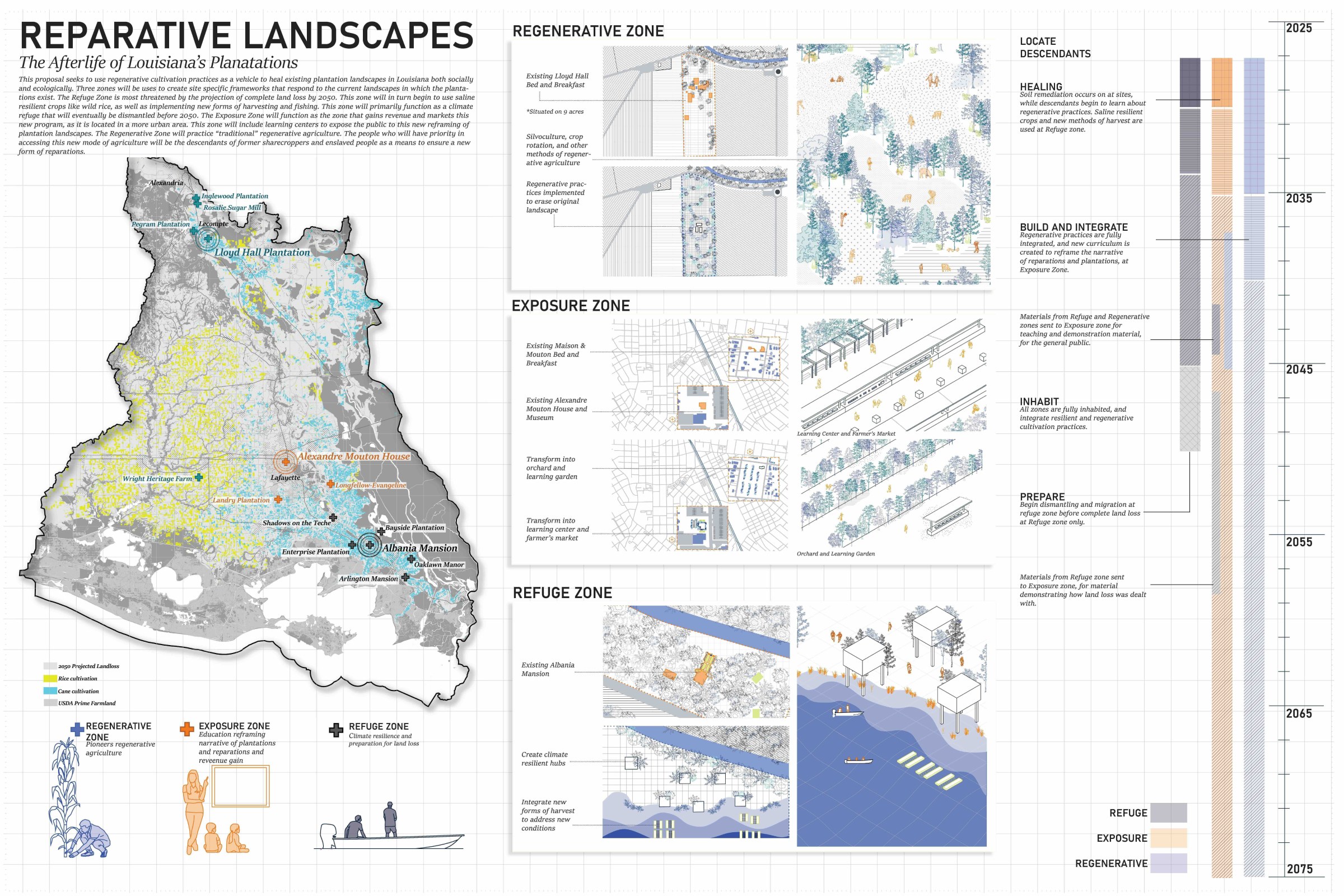
"Organized across four phases—systems research, propositional thinking, reciprocal landscape protocols, and design test fits—students ultimately develop multi-scalar architecture, landscape architecture, and urban design strategies for the Acadiana region that bridge coastal and inland communities. Final design proposals aim to explore the role designers can play in the adaptation of community-led food systems and to contribute to LA-FPC’s ongoing food policy advocacy work across Louisiana."
Congratulations to Professor Camuti and her team!
Related

Tulane-partnered proposal selected as finalists for $50 million Gulf Futures Challenge
A proposal by faculty at Tulane School of Architecture and Built Environment, in partnership with the University of Houston, has been selected as one of ten finalists for a national grant through the National Academies of Sciences, Engineering, and Medicine (NASEM) Gulf Research Program.
NASEM renews funding for Gulf Coast Climate Futures
Assistant Professor Liz Camuti, along with Professor Margarita Jover, have been awarded a $749,961 grant from the Gulf Research Program (GRP) at the National Academies of Sciences, Engineering, and Medicine to lead the “Gulf Coast Climate Futures” studio.